
Intertidal habitats and beautiful mudflats
Lydia Baxter · 10 Apr 2026 · 5 min read
What we came to look at
A peak Spring tide on Wednesday and Thursday was not what I expected to be on my ‘To See’ list in early March, but when your husband is a marine biologist who wants to investigate every nook and cranny of our salt water environments here on the East Coast (and West and South and North, if I’m being honest), it can creep its way into your plans all too easily. However, with my Crom Shed hat on (I hope to will this delightful hat into existence), I saw this as a brilliant opportunity to explore the Cromarty firth in a way that it rarely affords. With peak Spring tides comes the chance to experience the extremes of tidal ranges, allowing you to go exploring much further than you usually can during a ‘normal’ low tide. We counted ourselves lucky when we realized it was going to be a brilliant day for it too. The sun was shining, blue skies as her backdrop and nae a hint of wind.
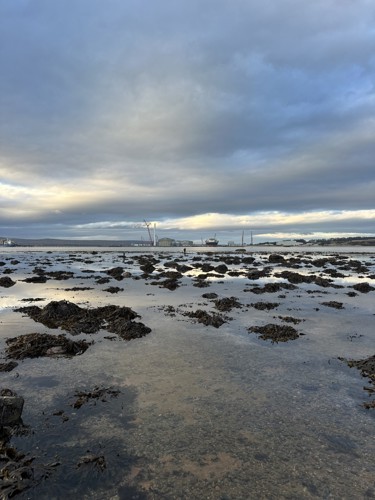 Cromarty Firth looking at Nigg Harbour.
South Sutors
For our romantic getaway on the Wednesday, my husband chose South Sutors as our destination, determined to find evidence of subtidal (Zostera) seagrass beds that had been mentioned by Hugh Miller, a geologist who grew up on the shores of the Cromarty Firth, in the 1850’s. It turns out that he very kindly described a huge boulder in the waters, which was identified as one of the ancient boundary stones of the township – Clach Mhallaichte, so we had a precise location and a goal! After parking up and popping our wellies on, we made our way towards the nice boulder (if you know, you know), over vast areas of now exposed marine habitat. Like a kid all over again, I was distracted by every small movement, bubble, squelch and wriggle, fully enthralled by this incredible living planet and her wonders that were there for us to see, for a magical short window. I found parcels of kelp forest, tiny yellow sea snails (flat periwinkles) smaller than my pinky fingernail, beautiful bright green egg sacks, starfish, crabs, common seaweeds, barnacles and limpets. Turns out, the intertidal zone is where it’s at! After witnessing my husband filling his wellies with sea water attempting to get to the big rock, I decided it was best to hang back and provide important moral support from afar as he took them off, balanced them on a nearby smaller rock, and waded into the cold water. Disappointingly, he couldn’t determine if the seagrass beds were still present, as the water was already on its way back in before he even made it to said big rock and so his report was “I couldn’t say for sure”. It is worth noting though that he wasn’t convinced it is suitable habitat anymore, given the large amount of kelp present that would block out the sunlight necessary for seagrass meadows to flourish. Off we went back home to our pups and for some grub.
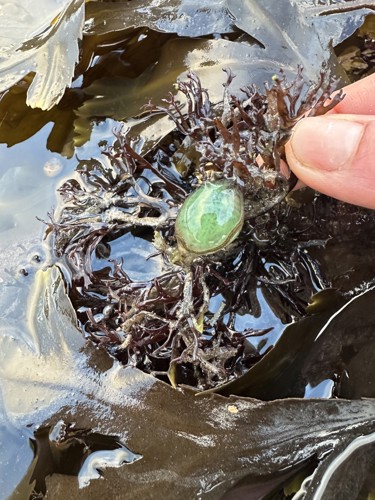 Green egg sack attached to seaweed.
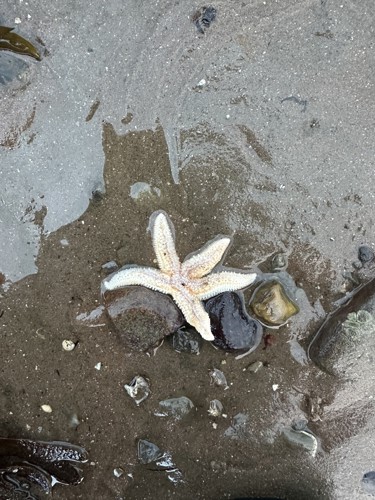 Exposed Common Starfish.
Alness Point
Thursday evening was much closer to home for us, with Alness Point (our regular dog walking port of call) as our chosen objective. This time my husband had come prepared with waders and boy did we look good. Squeaking our way out towards the water, I noticed how much harder it was to walk in clothing that doesn’t fit very well, especially when the mudflats were doing their best to recreate the Artax scene from The NeverEnding Story (quick PSA; if you haven’t watched it then prepare yourself for lots of tears). The first thing I clocked onto was the vast difference between the intertidal habitat at Sutors and the one here in Alness. The saturated, fine-grained sediment of the saltmarsh and mudflats was like thick, viscous sludge that my brain immediately likened to quicksand (despite only seeing it on TV admittedly), which meant different marine life was better suited to this environment to what I had seen the day before.
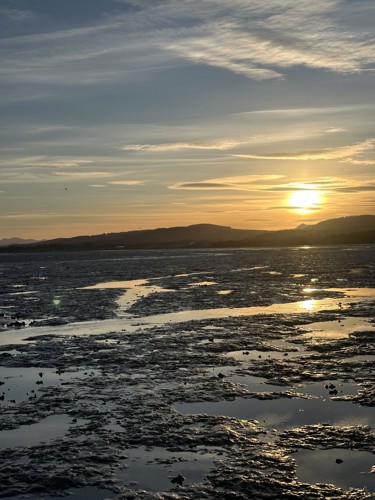 Alness Point mudflats towards the Wyvis range.
Here it was clear that the fertile mud made it ideal for many filter-feeding invertebrates (animals without a backbone), and as a result, wading birds too. The sounds of the oystercatchers, curlews, and even a great crested grebe were carried through the air as we investigated the vast expanse created whilst the tide was a very long way out. We encountered clumps of blue mussels that got ever larger the further out we went, remnants of oyster shells, bristle worms, lugworms, cockles and mud snails. I also found some weird and wonderful beings that convinced me that I had somehow made my way to Mars or had been transported back to ancient Greece with their mythical creatures. Upon doing my research, however, it turns out that I had come across paddleworms, spaghetti worms (my favourite name by far) and ragworms, which were all entirely new discoveries for me and confirmed the fact that it was indeed worth exploring somewhere that I thought I already knew so well. Again, my husband was not satisfied with staying closer to shore, so he decided to trudge as far as he could into the flats to make the most of this exceptionally low tide, which rewarded him with the location of the potential remains of a World War II vehicle and Horse Mussels! Given my extra-large, very snazzy waders, I didn’t very much like the idea of being on the news for getting stuck in the flats, so I decided to stay where I was, with my phone on standby in case he got into any trouble.
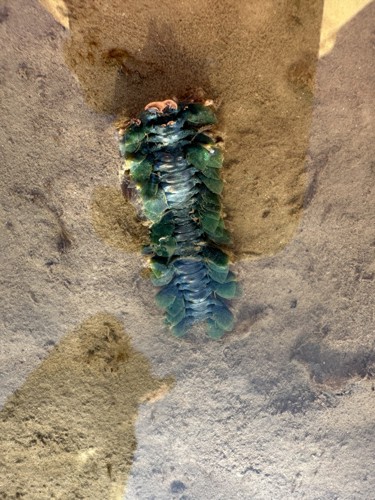 Deceased ragworm.
Upon his return, thankfully unscathed, we were both in awe of the incredible sunset that was slowly disappearing behind the Ben Wyvis range, so we stood and we watched, with the bird song and the shimmering water for company, until all that remained was the last of the light with its pink and orange hues guiding us back to the van.
Reflections, ID and Extra Resources
I am so thankful to live somewhere this beautiful, that is teeming with little lives, and to have this on our doorstep to reward our curiosity is a real gift.
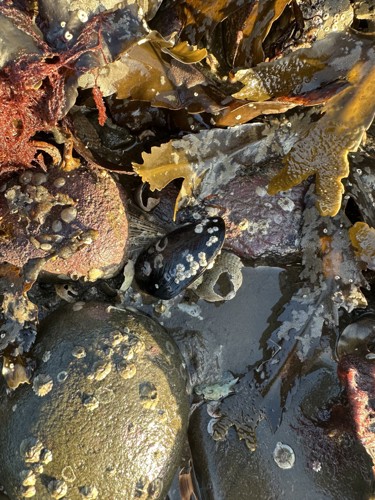 Blue Mussel surrounded by seaweed and rocks.
https://www.beachstuff.uk/marine_worms.html - worm ID
https://www.seabird.org/habitats/mud-flats - Information on mudflats
https://www.countryfile.com/wildlife/marine-life/rockpool-identification-guide - A funky rockpool guide
https://www.wildlifetrusts.org/habitats/coastal/saltmarsh-and-mudflats - Wildlife Trust saltmarsh and mudflats